The Do-It-Yourself Business Model Container

Get started

What you get

In a rapidly changing business world, this is the time value of a data or business model that matters. New ideas have to instantly get operational within a human readable data or process framework. Placed between a spreadsheet and an enterprise level system, the PL-Tool is a portable meso-scale rapid analysis and prototyping do-it-yourself package that provides you with the key capabilities to intuitively design, operate and manage your professional environment by yourself or together with your business peers.

  • Design

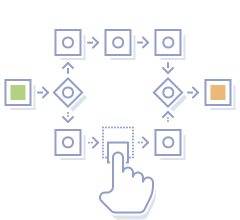
    As an innovative business developer you explore your data and process landscape, design the dataflow or the workflow model as you need, code the logic elements in a language of your choice and put it all together in order to make it ready for your organisation

  • Operate

    As an experienced operative officer you conveniently oversee your working environment, run your regular business in a solid and documented way and effectively communicate and distribute your results

  • Manage

    As a matured technology manager you secure your organisation needs with an adequately scalable and policy compliant system infrastructure, oversight and mitigate the related data and process complexities and benefit from additional resources contributing into a controlled code base


Read next

Role:

Operative Officer

The modest hero who keeps this crazy world running

Slider image

1. Check & Show.

  • Check: the capability to interactively simulate variable inputs and see the effect.
  • Show: the capability to visualize the analysis results in an easily consumable way (dashboard graphics, scatterplots, histograms etc.)
Slider image

2. Run & Get Assistance

  • Run: the capability to operate daily business processes in different ways (manually, event triggered, scheduled, etc. )
  • Get Assistance: the capability to guide the operative officer through a business process with a step-by-step wizard
Slider image

3. Comment & Report

  • Comment: the capability to tag business processes or resulting objects with personal searchable notes.
  • Report: the capability to manage and populate report templates in order to summarize and document the results in different formats (PDF, DOC, XLS, etc.)
Slider image

4. Share & Collaborate

  • Share: the capability to make personal or team results accessible for other colleagues
  • Collaborate: the capability to work together in team in order to jointly run business processes and achieve joint results.
Read next

Role:

Business Analyst

The great mind who shapes a better life for new generations

Slider image

1. Explore & Analyze

  • Explore: the capability to overview the data and process landscape and to drill down into the underlying data entities using different viewers (JSON, XML, rich text, database table, etc.)
  • Analyse: the capability to research on the data and process landscape and discover hidden information.
Slider image

2. Model & Prototype

  • Model: the capability to model the business data or process flow as a graph representation, with individual coding of the related business logic in graph nodes using a wide set of injected languages (Python, JavaScript, R, etc.)
  • Prototype: the capability to intuitively compose a working business process prototype from predefined component libraries.
Slider image

3. Design & Customize

  • Design: the capability to create a user interface out of predefined widgets.
  • Customize: the capability to align the look of the user interface to your needs and/or your corporate design
Slider image

4. Finalize & Distribute

  • Finalize: the capability to deploy your implemented business models into a personal production ready component library
  • Distribute: the capability to make your personal component libraries accessible by your colleagues
Read next

Role:

Technology Manager

The wise guy who makes sure that strong characters stay a strong family
Slider image

1. Operate & Scale

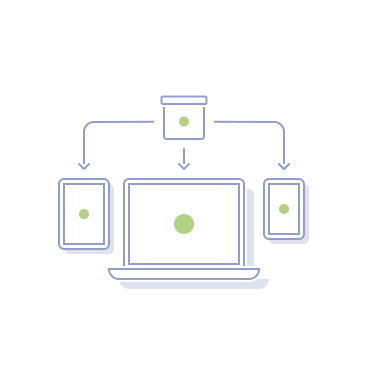
  • Operate: the capability to deploy and run PL-Tool as a portable platform independent solution.
  • Scale: the capability to configure the tool customised for any operation size, from single-user to worldwide.
Slider image

2. Encapsulate & Comply

  • Encapsulate: the capability to make the business design application logic be part of the organisation-wide code base.
  • Comply: the capability to impose and monitor standard policies for the coding activities of business users and fulfil related regulatory requirements.
Slider image

3. Orchestrate & Benefit

  • Orchestrate: the capability to delegate technological tasks to business users and integrate with corresponding code and incident management systems, increasing the technological resource base.
  • Benefit: the capability to optimize and measure technology performance indicators by proper allocation of business resources to technology development plans.
Slider image

4. Reimplement & Integrate

  • Reimplement: the capability to carve out the business logic coded within the workflow nodes and replace it with professionally developed functions within the PL-Tool namespace, enterprise-internal systems or cloud solutions.
  • Integrate: the capability to make the business logic within the PL-Tool securely interact with other enterprise applications via exchange of data, triggering process events or internet communication.